
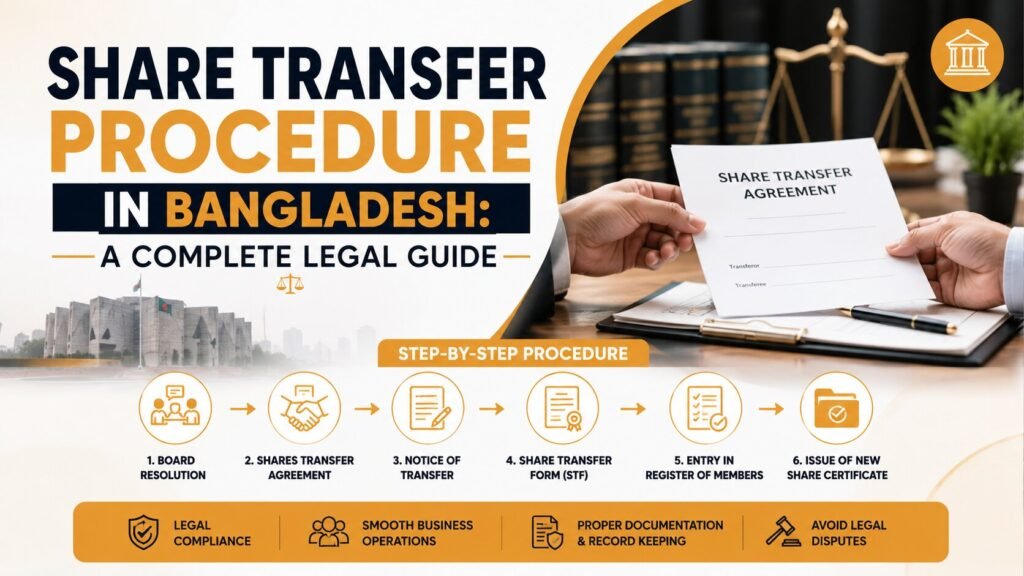
Share transfer is one of the most significant corporate activities for a private limited company in Bangladesh. It will enable shareholders to pass ownership to another person or company without breaking the law or causing any record-keeping issues. The process of transfer can occur for a variety of reasons, including investment, company growth, succession planning, and ownership changes, and it is crucial to follow the proper procedure. Knowing the legalities, required documentation, and approval process can aid companies in preventing conflicts, maintaining clarity, and guaranteeing that all transfers are in line with the Companies Act, 1994.
legaladvicebd.com is here to let you know about the share transfer procedure in Bangladesh!
What is a Share Transfer?
Share transfer is the legal way of transferring a share from the shareholder (transferor) to someone else or some organization (transferee). Once the transfer is complete and approved, the new shareholder will legally be the owner of the shares and the rights and privileges that come with the ownership of the shares.
For Private Limited Companies in Bangladesh, the Companies Act, 1994 and the AoA (Articles of Association) of the Company govern the share transfer. Some private companies have a private rule that no transfer of shares is permitted, and the shareholders should read the provision of an internal rule of the company before transferring shares.
There are many reasons why companies can transact transfers of shares:
- Recruiting a new investor
- Business restructuring
- Sale of ownership
- Family succession
- Retirement of an existing shareholder
- Internal ownership changes
- Signing or ratifying partnership agreements.
Legal Framework for Share Transfers in Bangladesh
The Companies Act, 1994 has laid the basis of the legal structure for share transfer in Bangladesh. Each private company, however, also has its own articles of association, which may include other terms for the transfer of shares.
For instance, numerous companies have clauses that stipulate:
- Give existing shareholders the first right to purchase shares.
- Need approval of the Board of Directors.
- Limit transfers to outside parties.
- Outline mechanisms to calculate share prices.
- Solicit written notification before making any transfer.
Due to these limitations, it is always advisable to review the Articles of Association before starting the transfer.
Documents Required for Share Transfer
Having the proper paperwork on hand reduces unnecessary delays in the approval process. While it may vary from business to business, the following documents are generally expected:
- Share Transfer Deed
- Original Share Certificate
- Board Resolution for Transfer of 2013-05-09
- Agreements from both the transferor and transferee
- Copies of national ID or Passport ● Updated Register of Members ● Share Transfer Register ● New Share Certificate ● Proof of payment of applicable stamps
The Acts of Association may require other documents to be provided. Accurate records mean there is a clear history of the trade and will provide a safeguard for the future.
Step-by-step Share Transfer Procedure
Step 1: Go through the Articles of Association
The first step is to take a look at the Articles of Association. When transferring a share, allow careful consideration of the company’s Articles of Association. The rules will decide whether there are any restrictions on the proposed transfer. For instance, the Articles can demand:
- First, to give the existing shareholders an offer to buy the shares. ● Notice in writing before sales of shares. ● Approval to change ownership before board approval. ● Adherence to valuation methods referred to in the articles.
Failure to make these provisions could end up postponing or even nullifying the transfer.
Step 2: Negotiate the Transfer
Once it has been determined that the transfer is acceptable to both parties, the commercial terms of the transfer are negotiated. This usually includes:
- Number of shares
- Selling price
- Payment method
- Date of transfer
- All rights and liabilities
of both parties will be transferred
For bigger deals, many firms have to use a Share Purchase Agreement to provide a clear understanding of these business terms before the legal transfer.
Step 3: Prepare and Execute the Share Transfer Deed
The most important document for a transfer is the Share Transfer Deed. The deed must be properly drafted and signed by the seller and the buyer. The general content of the document is:
- Name of the person transferring the property
● Name of the transferee
● Number of shares
● Class of shares
● Consideration amount
● Date of execution
● Place and date of document
This document is checked by the company before the transfer is completed.
Step 4: Pay the Applicable Stamp Duty
The Share Transfer Deed should be stamped as per Bangladesh law. The required stamp duty must be paid before the transfer can be registered by the company. Not meeting the stamp duty demands can postpone the endorsement process or lead to legal issues later.
Step 5: Submitting Documents to the Company
Completed documents should be returned to the company’s official or its company secretary. Typically, the submission will contain:
- Executed ST Deed
● Original Share Certificate
● A receipt for the stamp duty.
● Identification documents
● Additional statements to supply the context for the primary statement
The company examines these documents to make sure that everything has been completed correctly and then sends it on to the Board of Directors.
Step 6: Get Board Approval
In the case of the majority of private limited companies, the transfer needs to be approved by the Board of Directors before it is legally binding. At the meeting, the Board shall confirm, generally:
- Meeting the articles of association.
● The accuracy of documents submitted.
● The name of the new shareholder
● Finalization of legal procedures.
● The eligibility of the transferee
If the Board is satisfied, it adopts a resolution approving the transfer.
Step 7: Amending The Company’s Statutory Registers
If approved, the company makes changes to its statutory records. These usually include:
- Register of Members
● Share Transfer Register
● Shareholding records
● Ownership details
The updates to these registers are official and put the new shareholder on the legal record of the Company.
Step 8: Issue a New Share Certificate
The company’s statutory registers are updated and the old share certificate is cancelled and a new share certificate is issued in the name of the transferee. This certificate is a legal document showing the ownership of the shares and that the new shareholder is registered as such in the company’s Register of Members.
Companies should ensure that the certificate is signed by the authorized directors or officers as per the Articles of Association and the applicable laws.
Common Mistakes to Avoid When Transferring Shares
The process seems simple, but can be fraught with errors that can cause a delay in approval or legal issues later on. Companies and shareholders should make sure they do not make the following mistakes:
- Not reading the Articles of Association prior to the transfer.
● Lacking or misusing Share Transfer Deeds.
● Failure to have signatures of the transferor or transferee.
● Failure to pay the correct stamp duty.
● Promote postponement of Board action or documentation.
● Not updating the Register of Members after approval.
● Issuing new share certificate prior to all legal procedures.
● Maintaining incorrect or redundant company records.
Each step is crucial to ensure a seamless and compliant transfer process in line with corporate regulations in Bangladesh.
Benefits of Following the Right Share Transfer Procedure
The right share transfer process offers several advantages.There are several advantages to following the correct share transfer procedure.
There are several benefits to a well-executed share transfer for both the company and the shareholders. Legally compliant means that there’s transparency and no ownership issues in the future.
Some of the key benefits include:
- Clear and legal title to shares.
● Secure the rights and interests of shareholders.
● Complete and up-to-date statutory documentation for compliance purposes.
● Investors and business partners will have increased confidence.
● Reduced legal and administrative risks.
● Simplified investment and/or acquisition due diligence.
● Enhanced corporate governance and accountability.
● Improved prospecting and/or transition planning.
Documentation will also make audits, financial reporting and regulatory inspections easier to manage, giving the company greater confidence in its operations.
When Should You Seek Professional Assistance?
A simple share transfer may sometimes be achieved in-house, but it is advisable to seek professional assistance in cases involving multiple shareholders, foreign investors, large investments, or complex share ownership. Chartered Accountants, Company Secretaries and Corporate Lawyers can assist the company to prepare the requisite documents, ensure compliance with the Companies Act, 1994 and minimise the risk of expensive mistakes or delays.
Conclusion
The process of a share transfer is not just about changes in ownership; it is a legal procedure that plays a crucial role in ensuring transparency, safeguarding shareholder rights, and promoting good corporate governance. Companies can easily and legally transfer shares by reviewing documents, preparing documents, getting Board approval, paying applicable stamp duty, and updating company documents. A transfer may be made for investment, succession, or business restructuring, and by following the proper procedure, disputes are avoided, and the company remains fully compliant with corporate laws of Bangladesh.
Hopefully, you understood the share transfer procedure in Bangladesh!

At the helm of Legal Advice BD is our esteemed Managing Partner, Advocate Nashir Ahmed Kushol. With a passion for the law and an unwavering commitment to client success, Advocate Kushol’s leadership has been pivotal in shaping the firm’s legacy. His expertise and proactive approach to legal challenges ensure our clients are always in safe hands.